
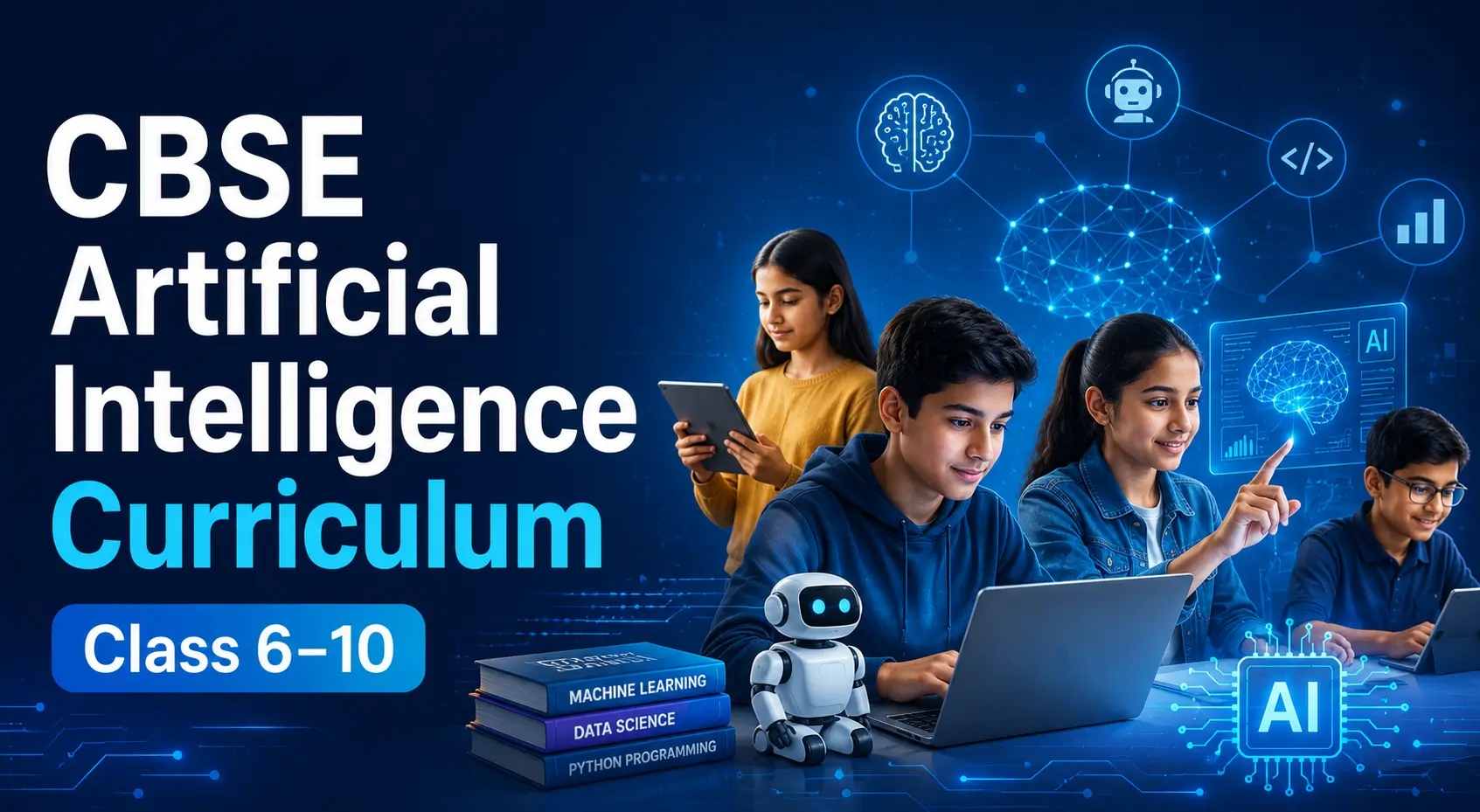
CBSE Artificial Intelligence Curriculum Explained: Class 6 to 10 — All You Need to Know
Admin2026-07-22T05:11:45+00:00Introduction
When CBSE introduced Artificial Intelligence into its school curriculum, it sent a clear signal: the future of education in India is digital, data-driven, and forward-thinking. But for many parents and even students, the question remains — what exactly is taught in CBSE AI, and how does it change from Class 6 to Class 10?
This article gives you a complete, class-by-class breakdown of the CBSE Artificial Intelligence curriculum, what students learn at each stage, and how it all connects to build genuine AI competency by the time students reach Class 10.
The Philosophy Behind CBSE AI Curriculum
The CBSE AI curriculum is not designed to turn every student into an AI engineer. Instead, it aims to:
- Build AI literacy — understanding what AI is, how it works, and where it affects our lives
- Develop computational thinking — the ability to break problems into logical, solvable steps
- Introduce practical tools — Python, data tools, and project-based learning
- Foster responsible AI thinking — understanding ethics, bias, and societal impact
Think of it as digital literacy for the 21st century — just as students learn to write essays or solve equations, they now learn to think in the language of data and algorithms.
Class 6 — First Introduction to AI
At Class 6 level, AI is not a standalone subject but is integrated into existing subjects and school activities. The focus is entirely on awareness and curiosity:
- What is technology and how has it evolved?
- Introduction to robots and automation — simple, age-appropriate examples
- How computers 'think' — basic computational logic through games and activities
- Digital citizenship: safe internet use, privacy basics, and responsible online behaviour
The approach at Class 6 is exploratory. Children learn through observation, storytelling, and guided play. The goal is to spark curiosity — not overwhelm.
DMA's Approach at Class 6: Our teachers use visual tools, short documentary clips, and classroom discussions to introduce AI concepts in engaging, age-appropriate ways.
Class 7 — Building Computational Thinking
Class 7 takes a step further into structured thinking:
- Algorithms: What is an algorithm? How do instructions become actions?
- Sequencing and logic: Simple flowcharts and decision trees
- Introduction to Scratch or similar block-coding environments
- How search engines work — a relatable AI example every student knows
- Introduction to data: What it means, where it comes from, and why it matters
Students begin creating simple digital projects — short animations, interactive stories, or basic quizzes using block coding tools. The transition from consumer to creator begins here.
Class 8 — Data, Patterns, and AI Applications
By Class 8, students are ready to connect AI concepts to real-world contexts:
- What is Machine Learning? How does AI learn from examples?
- Pattern recognition: How AI identifies images, voices, and text
- AI in everyday life: Recommendation systems, voice assistants, traffic management
- Introduction to Python (basic): Variables, loops, and simple programmes
- Data literacy: Reading graphs, understanding datasets, and basic analysis
- AI ethics in focus: Bias in AI, privacy in digital systems, responsible use
Class 8 represents a significant step — students move from understanding to doing. Simple Python programmes, data exercises, and class discussions on AI ethics give students both skills and perspective.
Class 9 — AI as a Formal Skill Subject
From Class 9, AI becomes a formal CBSE Skill Elective (Subject Code 417) with structured assessment. The curriculum becomes more rigorous:
Unit 1: Introduction to AI
- History of AI and key milestones
- Domains of AI: Natural Language Processing, Computer Vision, Robotics
- How AI differs from traditional computing
Unit 2: AI Ethics
- What is ethical AI?
- Bias in data and AI systems
- Privacy, surveillance, and data rights
- AI's societal impact — jobs, accessibility, environment
Unit 3: The AI Project Cycle
- Problem scoping: Identifying a real-world problem AI can solve
- Data collection: Gathering relevant, quality data
- Data exploration: Visualising and understanding the data
- Modelling: Creating a simple AI model
- Evaluation: Testing and improving the model
Unit 4: Python and Data Tools
- Python basics: Variables, data types, loops, conditions, functions
- Introduction to libraries: Pandas, Matplotlib
- Creating simple data visualisations
Class 10 — Applied AI and Capstone Projects
Class 10 brings it all together with deeper application and a Capstone AI Project:
- Advanced Python: Working with real datasets using Pandas and NumPy
- Machine Learning Models: Supervised learning with examples (regression, classification)
- Model Training and Testing: Train-test split, accuracy evaluation
- AI Application Domains: Agriculture, healthcare, education, smart cities — with Indian case studies
- Neural Networks: A conceptual introduction to deep learning
- Capstone Project: Each student designs, builds, and presents an AI model addressing a real problem they care about
The Capstone Project is the crown jewel of Class 10 AI. Students choose a problem — it could be detecting plant disease from photos, building a smart attendance system, or creating a recommender for local services — and use the full AI project cycle to deliver a working solution.
How Assessment Works Across Classes
- Classes 6–8: AI integrated into regular school assessments, projects, and digital work portfolios
- Class 9–10: Formal CBSE assessment — 50 marks theory exam + 50 marks practical/project
- Practical marks include: Live coding demonstration, project portfolio, and viva
This means a student who consistently works on their AI projects throughout the year has a significant advantage in both marks and actual skill.
What DMA Does Differently
At Dayawati Modi Academy, we treat CBSE AI not just as a subject to be taught, but as a skill to be developed. Our differentiators include:
- AI Labs: Dedicated lab sessions with Python installed and ready on every workstation
- Project Mentorship: Teachers provide weekly one-on-one guidance on Capstone Projects
- Inter-School Showcases: DMA students present AI projects at competitions and science fairs
- AI Awareness Workshops: For parents, so families can support learning at home
- Continuous Updates: Our faculty stays updated as CBSE evolves the AI syllabus each year
Frequently Asked Questions
Q1: When does AI start in CBSE curriculum?
AI concepts are introduced from Class 6 in integrated forms. It becomes a formal CBSE Skill Subject (Code 417) from Class 9, with structured theory and practical assessment. Class 11 and 12 students can also opt for AI as an elective.
Q2: Is Python taught in CBSE AI?
Yes. Python is introduced at Class 8 level in an exploratory way and becomes a core part of the Class 9 and 10 curriculum. Students learn to write Python programmes, work with data libraries, and create simple AI models using Python.
Q3: Can a student without coding experience take CBSE AI in Class 9?
Absolutely. The CBSE AI curriculum is designed for students with zero prior coding or AI experience. It starts from the very basics and builds progressively. With good teaching support, any motivated student can succeed.
Q4: Does CBSE AI affect my child's core subject marks?
No. AI (Code 417) is a 6th optional subject and does not replace any core subject. It is counted separately on the marksheet and does not affect the percentage calculation for core subjects (unless your child wants to count it in their best-of-five or best-of-six calculation).
About Dayawati Modi Academy
Dayawati Modi Academy (DMA) in Modipuram, Meerut is a leading CBSE school offering structured AI education from Class 6 to Class 10. Our faculty, infrastructure, and curriculum approach ensure that every student — regardless of prior experience — develops meaningful AI skills. Learn more at www.dma1.in.


Leave a Reply